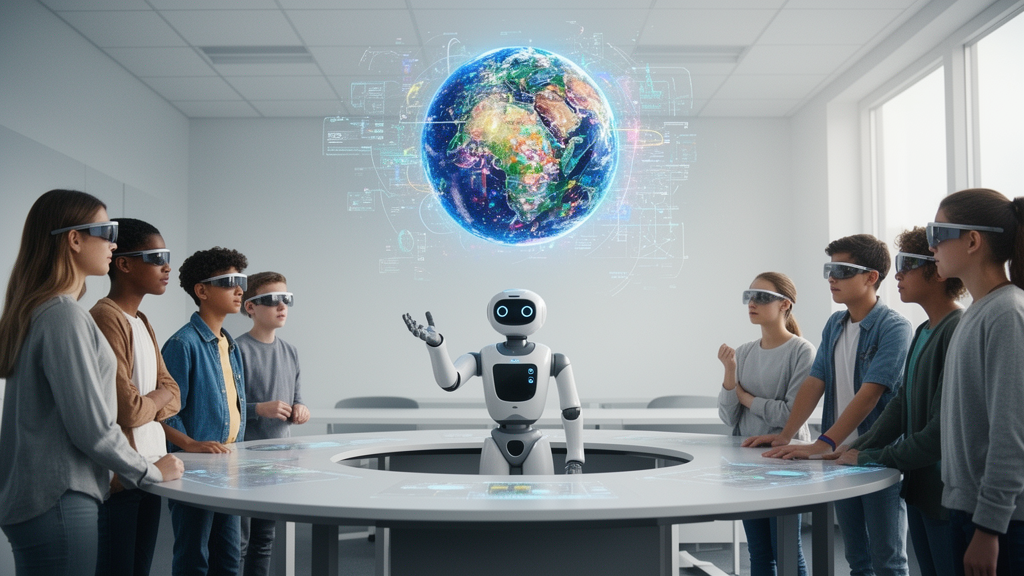
Researchers at The Education University of Hong Kong have developed a mixed reality environment called Embodyverse, which integrates an embodied artificial intelligence robot to support socially shared regulation of learning. Published in Computers & Education: X Reality in December 2026, the study presents a design and development framework for this hybrid system, along with insights from a pilot implementation. The system aims to address gaps in existing mixed reality educational tools by providing adaptive, group-level support rather than focusing solely on individual learner performance. By combining physical robotic interaction with digital virtual elements, Embodyverse seeks to enhance collaborative learning processes in authentic scientific inquiry contexts.
The theoretical foundation of Embodyverse is grounded in socially shared regulation of learning, a concept that extends self-regulated learning to group-level co-regulation. In this framework, learners collectively plan, monitor, and evaluate their learning as a cohesive unit, rather than merely coordinating individually regulated activities. The system operationalizes this through four interrelated phases: task preparation, goal setting and planning, performance, and reflection and adaptation. Adaptive support is designed to be contingent on group-level processes, providing metacognitive, cognitive, and socio-emotional assistance through the embodied AI robot, which functions as a co-regulatory agent to support shared awareness and timely coordination.
Technically, Embodyverse represents a novel integration of mixed reality technologies with embodied AI robotics, creating a hybrid space where digital and physical realms converge. The environment is accessed via mixed reality headsets, such as the Meta Quest 3, while a custom-embodied AI robot and tangible components facilitate interactions in the physical environment. The technical architecture utilizes the Unity Engine as the development platform, with custom scripts written in C# to synchronize virtual anchors with the physical robot’s positions. This layered approach mitigates latency issues common in mixed reality systems and enhances immersion by ensuring spatial coherence between the virtual and physical domains.
A key feature of the system is its marker-tracking mechanism, which employs QR codes as fiducial markers to facilitate precise localization and interaction initiation. This approach was selected for its simplicity, cost-effectiveness, and high accuracy in real-time tracking, making it suitable for educational settings where reliability is paramount. Unlike more computationally intensive methods such as simultaneous localization and mapping, QR code-based methods provide robust detection with minimal setup requirements. The system integrates a monocular camera mounted on the robot with the headset’s built-in camera to detect and decode these markers, triggering immersive interactions when users direct their gaze toward specific physical locations.
The embodied AI-driven robot serves as a pivotal component, bridging virtual mixed reality elements with tangible interactions. It is engineered to embody cognitive capabilities akin to human-like reasoning while maintaining affordability and adaptability for real-world deployment. The robot’s architecture integrates vision-language models, such as Gemini-Flash-3 or GPT-5 series, which process multimodal inputs including visual data from cameras and dialogue information from user behaviors. This enables the robot to interpret environmental scenes, understand natural-language commands, and execute actions in synergistic coordination within the mixed reality environment.
The robot’s intelligence is structured around a three-layer pipeline comprising perceiving, reasoning, and acting. In the perceiving stage, raw video streams from the robot’s cameras are processed using OpenCV to extract and enhance framed pictures for efficient input to the vision-language models. The reasoning stage utilizes pre-trained models adapted through prompt engineering and Retrieval-Augmented Generation, which retrieves external data from a vector database to enhance response accuracy and prevent hallucinations. Finally, the acting stage translates reasoning output into executable actions, interfacing with the robot’s behavior and the mixed reality environment through controllers for audio and emotional output, coupled with speech synthesis via text-to-speech engines.
To operationalize the theoretical framework, an early prototype of Embodyverse was piloted using a plant growth scenario focused on seed germination. Fourteen participants from a public university in Hong Kong experienced the system using mixed reality headsets, engaging in collaborative exploration of the biological conditions required for germination. The scenario involved multiple interacting variables, such as water, temperature, and light, making it suitable for eliciting hypothesis generation, goal-setting, and experimental planning at the group level. Data were collected from participant discussions and feedback during and after the pilot implementation, providing insights into the system’s effectiveness and usability.
During the pilot, the embodied AI robot provided metacognitive support, prompting learners to prepare, set goals, perform, and reflect on the learning task. The support was adaptive and delivered through verbal feedback, with the robot continuously checking system logs for task item completion status. If required items remained incomplete, the robot triggered metacognitive prompts to encourage learners to revisit and complete them. Learners’ written task entries were analyzed using large language models, enabling the robot to provide targeted feedback on the clarity and coherence of the task items. This approach ensured that the support was aligned with the group’s evolving regulatory demands rather than being static or one-size-fits-all.
In the performance phase, learners interacted with the mixed reality environment by manipulating environmental conditions and observing germination processes. The system visualized key biological processes, such as water imbibition and differences between epigeal and hypogeal germination, which are typically invisible to the naked eye. A vision-language model-based perception mechanism detected visual cues associated with watering behavior, such as the presence of a watering container and relevant hand movements. When the system inferred that watering had occurred, it triggered corresponding events in the mixed reality environment, such as initiating a seed germination animation, thereby linking physical actions to virtual outcomes.
The pilot implementation demonstrated several strengths, including the successful integration of physical-virtual interaction and the provision of a convenient and reliable means of linking physical artifacts with virtual content. Participants reported that the embodied AI robot demonstrated potential as a co-regulatory agent by delivering intelligent feedback in response to their questions. However, the study also revealed limitations, such as the need for improved spatial interface design to prevent visual discomfort caused by inconsistently positioned virtual elements. Additionally, the reliance on QR-code scanning was noted to interrupt the natural flow of interaction, suggesting a need for more naturalistic interaction modalities such as voice activation and gesture recognition in future iterations.
System latency and occasional instability were also reported, negatively affecting the sense of immersion and interaction. Addressing these issues requires optimization of system performance and robustness for real-world deployment. Future work can enhance the intelligence and responsiveness of Embodyverse by integrating more advanced AI approaches, such as world models and spatial intelligence, which could enable the system to process multimodal inputs and support real-time understanding of learners’ needs. The current implementation reflects a pilot, small-scale deployment, and future research will involve a larger sample with a rigorous research design to further validate the system’s effectiveness.
Despite these limitations, the pilot findings indicated that Embodyverse offered positive contributions to the learning experience, including an immersive and interactive environment that facilitated collaborative engagement. The structured socially shared regulation of learning framework provided a theoretically grounded process that supports collaborative learning, while the integration of seed germination science tasks demonstrated the potential of the system to support experiential learning. The study contributes to the literature by providing novel perspectives on adaptive support for socially shared regulation of learning in collaborative contexts, highlighting the potential of embodied AI robots in mixed reality educational environments.
Beyond software integration, the physical construction of the robot relied on three-dimensional printing using polyethylene terephthalate glycol, selected for durability, flexibility, and impact resistance. The outer structure featured modular exoskeleton surfaces created through parametric modelling to accommodate varying morphologies. Snap-fit mechanisms enabled educators to interchange external modules across subjects, while flexible printed circuit boards embedded during printing connected directly to the robot’s microcontroller.
During the seed germination trial, learners examined five dicotyledonous seed varieties: peanut, broad bean, red bean, mung bean, and soybean. Individual entries were restricted to the task preparation phase to establish learner profiles, after which all collaborative stages functioned at the group level through designated student representatives. Rather than answering domain-specific inquiries directly, the robot provided metacognitive guidance. For instance, when a group submitted an unrefined plan to test water before considering other factors, the system identified missing hypotheses and division of labour, prompting the team to articulate how their experimental choices connected to their underlying inquiry questions.
In the performance phase, the headset captured visual frames at five-second intervals, routing them to a local vision-language model that triggered germination simulations once a learner sustained a watering gesture over a plant container for over five seconds. The concluding reflection phase then prompted groups to transfer strategies toward future topics, including seedling growth and photosynthesis. Student evaluations noted that while collaborative inquiry succeeded, engagement was constrained by the absence of gamification, narrative storytelling, and reward systems, and interface elements occasionally distracted learners from full physical immersion.
Subject of Research: Embodyverse: Developing an embodied AI robot-supported mixed reality environment for socially shared-regulation of learning
Article Title: Embodyverse: Developing an embodied AI robot-supported mixed reality environment for socially shared-regulation of learning
Article References: Song, Y., Lee, J. C.-K., Wu, K., Ding, J., & Que, Y. (2026). Embodyverse: Developing an embodied AI robot-supported mixed reality environment for socially shared-regulation of learning. Computers & Education: X Reality, 9, Article 100164. https://doi.org/10.1016/j.cexr.2026.100164
Image Credits: AI Generated
DOI: 10.1016/j.cexr.2026.100164
Keywords: Embodyverse, Developing, embodied, robot-supported, mixed, reality, environment, socially, shared-regulation, learning
News Source: Denise Maddox. (November 26, 2026). AI Robot Supports Group Learning in Mixed Reality. Scienmag.